
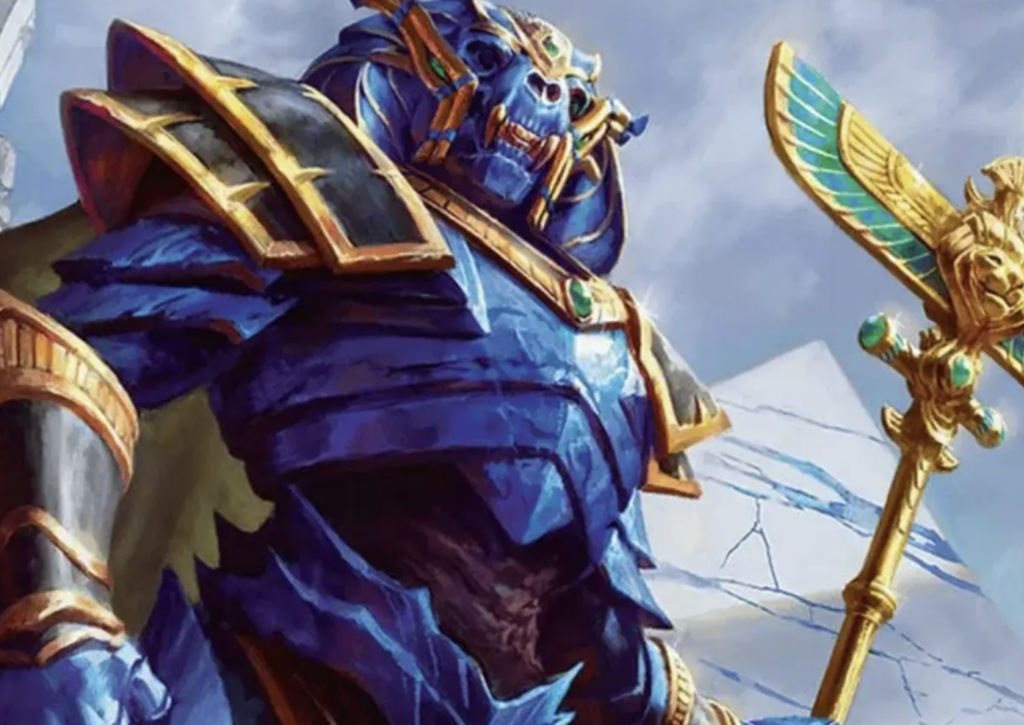

Hashaton, Scarab’s Fist is not a commander that ask you to attack like a regular creature. Hashaton only costs {W}{B} Zombie Wizard, which means he comes down early and starts threatening value long before other deck get moving. This is a graveyard deck, but not in the usual reanimator way. He rewards you for discarding creature cards, then let you pay {2}{U} to turn that discard into a tapped 4/4 black Zombie copy of that creature.
This is the mistake if you try to make the deck to be Zombies tribal pile just because the tokens happen to be Zombies. You will be limited yourself into just Zombies, and there are a lot of other more great creatures you will be missing.
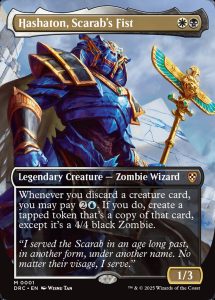
Hashaton, Scarab’s Fist
Mana Cost: {W}{B}
Type: Legendary Creature – Zombie Wizard
Text: Whenever you discard a creature card, you may pay {2}{U}. If you do, create a tapped token that’s a copy of that card, except it’s a 4/4 black Zombie.
What Hashaton actually wants
Discard outlets: If you cannot discard when you want to, Hashaton is not really driving the deck, he just sitting there waiting for something to happen.
Creatures worth copying: You want creatures whose abilities still matter when copied, whether a strong ETB effect, useful static ability, death trigger, or some other kind of impact that makes the token worth the mana. When 1 copy is not enough, double it with Anointed Procession.
Graveyard follow-up: Creature card still ends up in graveyard after being discarded, you want to keep using the graveyard after the discard happens. You get the token copy now, later can still reanimate the original creature. That give the deck a very strong double-value pattern.
Mana support: Each trigger cost {2}{U}, the deck needs enough mana to keep the engine moving. If you want explosive turns, your mana has to be able to support it.
That’s it! That’s the real shape of the deck. You load the graveyard efficiently, turn discarded creatures into board presence, then continue squeezing the value from the original cards that still laying in the graveyard.
Discard outlets
Hashaton only can start doing broken things when you have reliable ways to discard creature cards whenever you want. That turning Hashaton to real threat when moving creatures from your hand into the graveyard again and again, and setting up token copies.
The Underworld Cookbook gives you a reliable way to pitch creatures on demand, with extra Food production which is nice as well to help you stay alive. Second ability lets you bring back creature from graveyard back to your hand is a nice loop where you can discard it again, and make another copy with Hashaton.
Matzalantli, the Great Door, the front side is already giving what Hashaton needs, by helping us draw and filter your hand. You can transform it for extra mana later in game which is nice to help you pay for Hashaton’s ability.
Every cards you discard comes with extra value with Monument to Endurance. Drawing a card, making a Treasure, or draining opponents for 3 life are all useful options. This make your discard turns feel much heavier.
Bonded fetch and obsessive stitcher are straightforward, let you draw a card and discard at your choice. Bonded Fetch having haste which is nice because can start working immediately. Obsessive Stitcher second ability will be very useful later in game instead of only being an early setup card.
Likeness Looter is even more interesting and the ability is great in this deck. Early on, it helps to filter the cards in hand. Did you miss the chance to create your copy using Hashaton? Worry not, Likeness Looter will become that creature, downside of course is that copying a high CMC creature can be a bit clunky, but the flexibility is excellent.
I still remember the day I play Azorius control in Standard with Dream Trawler. It can get buff quite fast, and the discard ability does a lot here. It protects itself, and trigger Hashaton. It’s not just a strong synergy card for Hashaton, it’s also one of those cards that brings back a bit of MTG Arena nostalgia for me.
In general, the best discard outlets are the ones that cost little to no manage to activate. That matters because every mana you save on discard side make it easier to pay for Hashaton’s trigger, you have much better chance of chaining multiple discards in one turn.
Discard Creatures
Once the discard outlets are in place, next question is: What creatures are actually want to discard away?
With Hashaton, Scarab’s Fist, not all creatures are exciting to discard. You want to discard the one give you immediate value when the copy token enters, create a strong board that make paying {2}{U} feels completely worth it.
A good way to think about it is to ask what role you want that discarded card to play.
#1 Do you want to swing big?
Well, you can’t really “Swing big” as all the token going to be 4/4. However, Archon of Cruelty is one of the nastiest things you can discard in the deck. Forcing an opponent to sacrifice creature/planeswalker, discard a card and lose 3 life, while you draw 1 card and gain 3 life. Might not consider much in edh, but stacked together they create a very real gap.
#2 Do you want to build up your board or card advantage?
Let me start with Bone Miser, it synergy well with Hashaton (work like Monument to Endurance), because it turns every discard (not only creature) into extra material. Discarding creature card not only trigger Hashaton, but also you get 2/2 Zombie on top of it. If you discard a land, you get mana back. If you discard another spell, you place it with a card. This makes your discard outlets feel much stronger and gives the deck more flexibility.
Don’t let your creature stay in the gravayard, recurring it using Ardyn, the Usurper, or even better with Reya Dawnbringer. You not only able to cast creature from your hand, but now you able to ‘play’ it from your graveyard as well. This is strong as your opponent now need to find a way to deal with your graveyard.
Discard based decks like Hashaton can sometimes dump resources into the graveyard to build a stronger board, eventually will run out of gas if the table answers it. Nezahal, Primal Tide not only just a big body (7/7 if you cast it), it also acts as a steady card advantage engine by drawing a card whenever opponents cast noncreature spells. That helps to refill your hand.
#3 Do you want to board wide?
Do you want to punish creature decks and dominate the table? Elesh norn, Grand Cenobite turns your small board into serious attackers, while shrinking opponents boards at the same time. She gets even nastier next to Massacre Wurm. Together, they can punish token deck or board full of utility creatures, with the life loss from Massacre Wurm, it makes your opponents regret overextending.
#4 Do you want to scale you board?
Some creatures are less about immediate damage, and more advantage in longer games. Sire of Stagnation is strong in slower pods. It not only pressure ramp decks, but also gives you card advantage.
Hashaton produce tokens regularly, Ojer Taq, Deepest Foundation help you by multiplying your own board presence.
#05 Do you want to protect your board?
Not every cards need to be haymaker, some are worth discard because protect the rest of your tokens.
Gleaming Overseer amasses Zombies 1 when it enters, and more importantly, it gives your Zombie tokens hexproof and menace, which matters a lot since Hashaton is building board presence through Zombie tokens.
That is really how you should think about creature selection in Hashaton. Don’t load the deck with expensive creatures and hope for the best. Pick the creatures that each serve a purpose, some hit hard, some keep the cards flowing, some control the board, and some protect and scale your tokens.
The mixture of creatures makes the deck dangerous and unpredictable to deal with. Each discard represent a different kind of threat. Over time, your graveyard stops being a pile of discarded cards and starts feeling like a toolbox full of threats.
Common Mistakes
Hashaton can be very explosive when the deck is working, mistake with this deck do not come from card choices alone, but when trying to do too much too early.
One of the most common mistake is keeping opening hands with expensive creatures but no discard outlets. Those hands can look tempting because contain your best payoff cards, but without a way to move them into graveyard, they usually stay in your hand doing nothing. Hashaton is not a deck that wins by casting spell on curve, he wants to setup the board first. An opening hand with discard outlet, some mana, and 1 good discard creature is often much stronger than a hand full of big creature but no discard outlets.
It’s very easy to overfill graveyard without applying real pressure. This deck can draw and discard efficiently, sometimes it feels like you are doing a lot when in reality you are just stocking the graveyard and passing the turn. Filling the graveyard is not the goal by itself. The graveyard only matters if it is helping you answer the threat and push the game forward. For example, you copy Massacre Wurm while sending him into graveyard when the board has only one or two small utility creatures. Yes, you still get the body and opponent lose some life due to their creatures died, that is so little value. On the next turn, token player untaps and starts building a much wider board, now your best anti-token creature is already gone and the window where Massacre Wurm could have truly swung the game has passed.
Hashaton can recover from removal(Destroy) better than many decks, but exile is a different story. If the table showing graveyard hate and exile removal, you have to be more careful about how much you commit. Do not dump your whole plan onto the battlefield just because you can. Play more strategically, try to make your opponents to use their interaction before you commit your stronger creatures.
Weaknesses and counter play
This deck is commander dependent. Hashaton is the card that ties the whole strategy together. You can draw, discard, and fill your graveyard without him, but there is no threat at your side when those discarded creatures are no longer turning into token copies. Deck still works by hard casting the creatures or reanimate them, but you’ll lost half the synergy without Hashaton on the battlefield.
The deck is not completely shut down by graveyard hate, but it does lose part of its value engine. Hashaton can still discard and make token copies, main game plan continues to function. The real loss is the follow-up, cannot reanimating threats, and recurring key creatures.
Best way to play against graveyard hate is stop treating your graveyard like a place to stock your creatures. The goal is to turn discarded creatures into immediate pressure before opponents get them in graveyard, force opponents to answer what is already on battlefield. Also avoiding too many ‘premium creature’ into the graveyard at one. When the graveyard gets hit, you are losing future value instead of your entire turn.
This deck can feel slow if it doesn’t find an enabler. A hand full of strong creatures does not mean much if you cannot actually discard them. This is one of the reason discard outlets matter so much. You deck is your toolbox, full of strong creatures that answer a different threat. (put some example like tutor to find the enabler)
Final Thought
Hashaton, Scarab’s Fist looks like it’s just about discarding big creature and making copies. But you are not just dumping creatures into graveyard and hoping they matter later, you are choosing the right threat for the right moment, and making every discard count.
That is what makes this deck strong and satisfying to play.
The answer was always there.
– draw9;